What goes where, what stays out, and how to stop plates shielding one another from the water.
Why this arrangement works
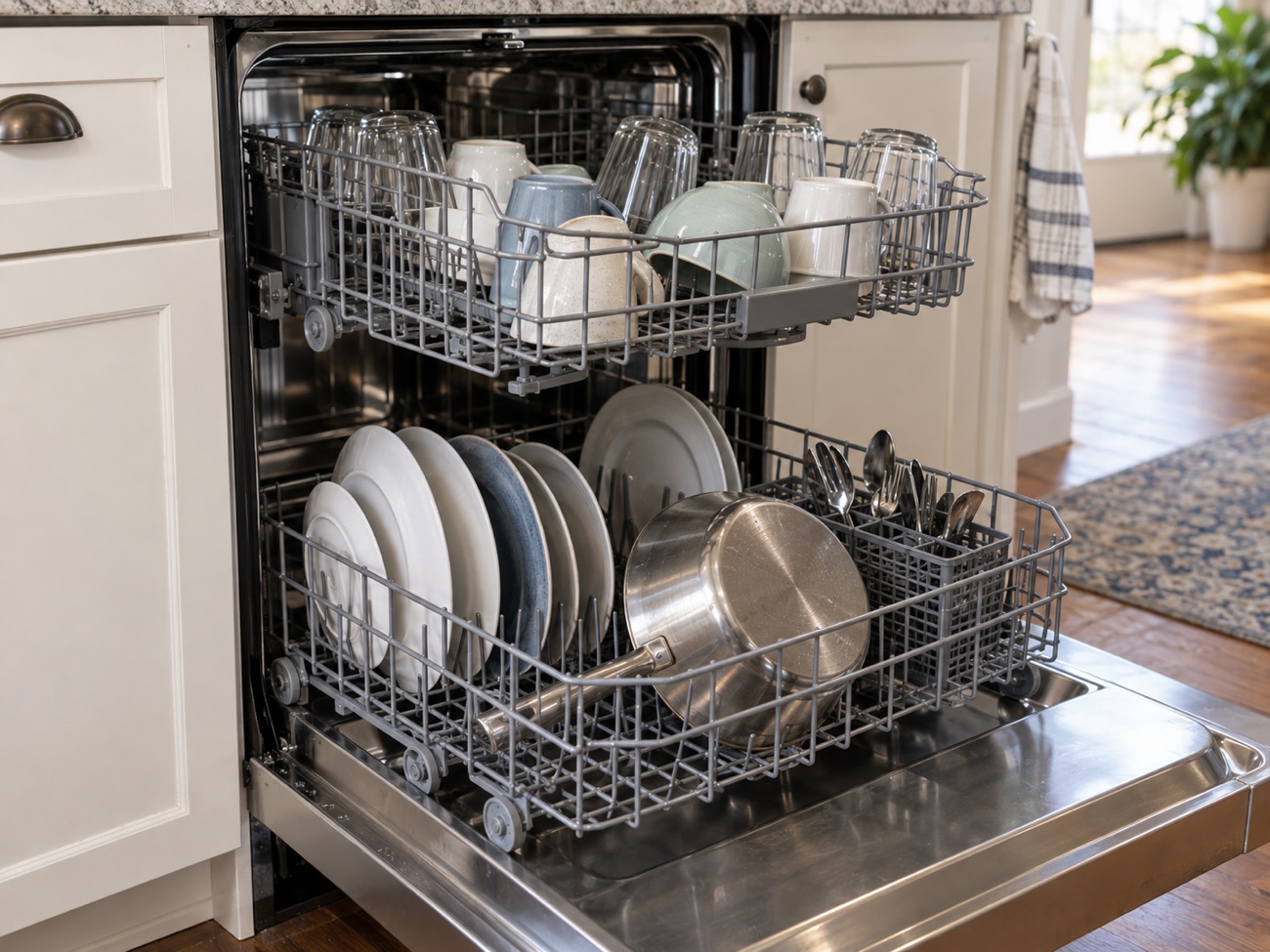
The spray arms do not negotiate. They rotate through a fixed path and throw water from predictable positions. Good loading is simply the practice of giving that water an unobstructed route to the mess.
This is general guidance for domestic dishwashers. When your rack, item, detergent, or appliance manual says something different, follow the specific instruction.
01
Required equipment
Gather the apparatus.
✓
Dishwasher
Any domestic model. Your manufacturer’s manual outranks this general guide.
✓
Dishwasher detergent
Use the product and quantity recommended for your machine and water hardness.
✓
Scraper or cutlery
For removing bones, toothpicks, and loose food before loading.
Safety orders
Before proceeding
Sharp knives stay out
Wash chef’s knives by hand. If ordinary table knives use the basket, place sharp points down and handles up.
Confirm items are dishwasher-safe
Check the item or manufacturer guidance. Wood, cast iron, delicate glassware, and many insulated items generally need hand-washing.
Follow the machine manual
Rack designs, detergent compartments, cycles, filters, and loading limits vary by appliance.
02
Visual reference
Know the working zones.
Example load, not a universal rack layout. Check your appliance manual and keep a clear path for the spray.View the labelled loading diagramReference plate 01 General loading zones. Your appliance manual has final authority.
Two-minute rack test
Where does it go?
Six items. Three destinations. Drag an item onto a rack or the sink. Prefer tapping or a keyboard? Select an item, then choose A, B, or C.
Select an item, then choose where it goes.
03
Standard procedure
5 defensible moves.
01
Scrape, do not pre-wash
Remove bones, toothpicks, large scraps, and excessive grease. Modern machines generally do not need a full sink rinse first.
Inspection: No loose chunks remain, but the plate has not already been washed by hand.
02
Give the water a route
Face dirty surfaces toward the centre or spray arms. Keep items separated so one bowl or plate does not shield another.
Inspection: You can trace an open path from a spray arm to every dirty surface.
03
Put lighter items upstairs
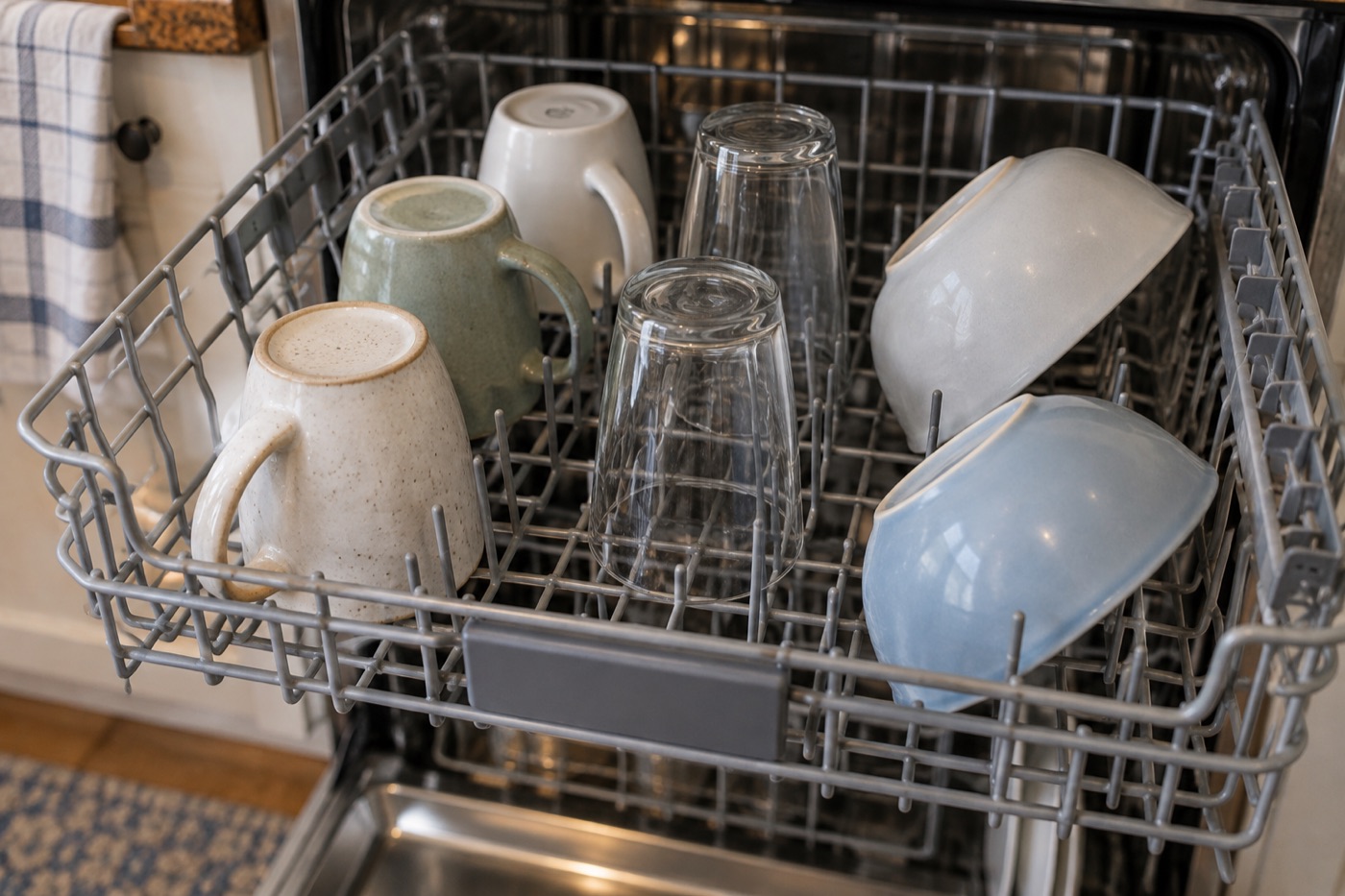
Cups, glasses, small bowls, long utensils, and dishwasher-safe plastics usually belong on the upper rack.
Upper rack: cups down, bowls tilted, space for the water to reach them.Inspection: Nothing can fall through the rack or flip over, and plastics are marked dishwasher-safe.
04
Put sturdy items downstairs
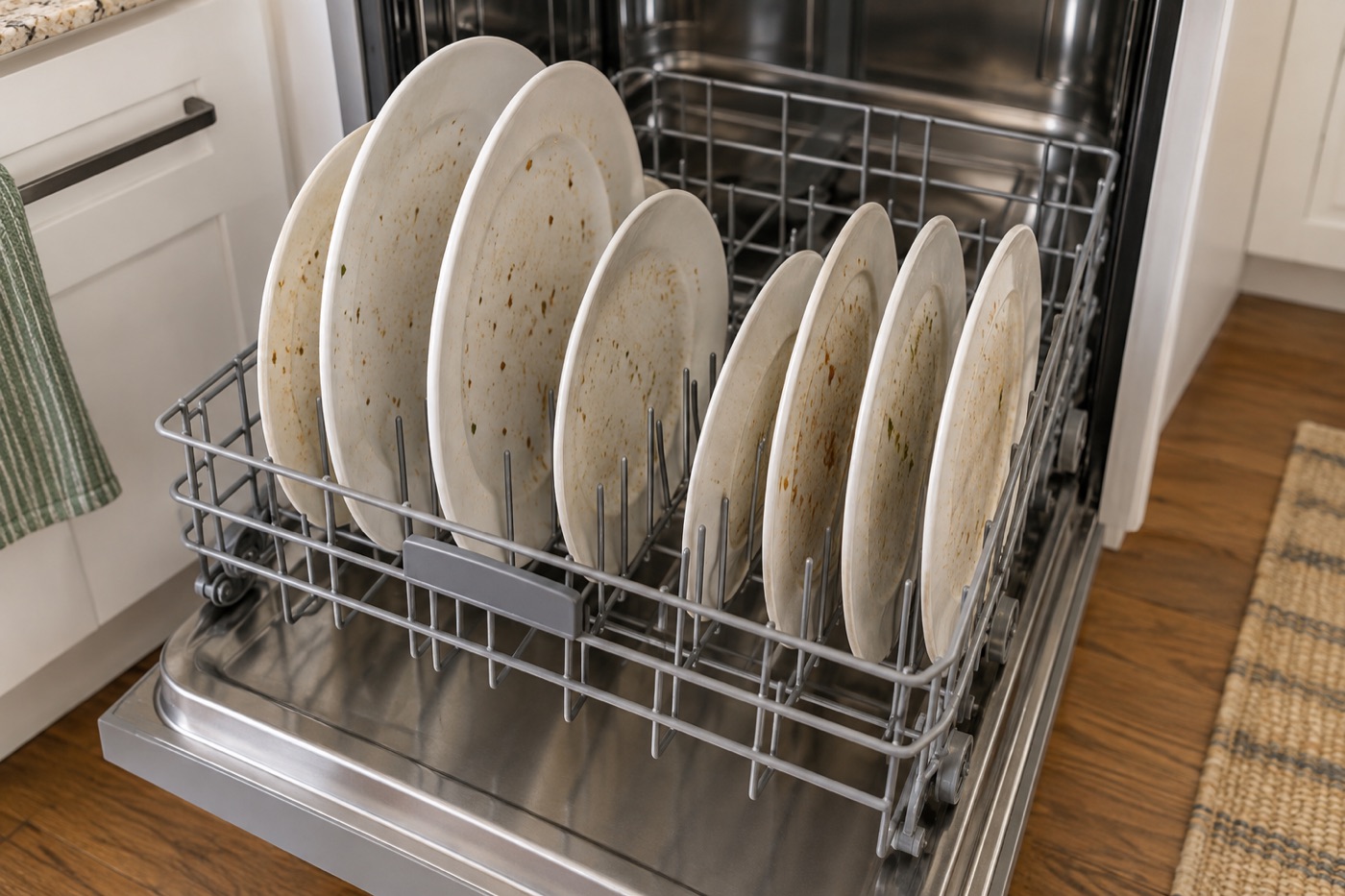
Plates, serving dishes, and dishwasher-safe pots belong on the lower rack, angled toward the spray and away from the detergent door.
Lower rack: each plate gets its own slot. Your machine’s layout may differ.Inspection: Large boards or trays are not blocking water, the dispenser, or a vent.
05
Perform the spin test
Turn each spray arm gently by hand before closing. Reposition anything that catches, hangs down, or blocks rotation.
Inspection: Every spray arm completes a full turn without touching the load.
04
Common failures
Where the operation tends to go sideways.
×
Nesting bowls and spoons
Touching surfaces create sheltered areas. Alternate utensils and leave gaps between dishes.
×
Treating capacity as a challenge
A packed machine is not an efficient machine when water cannot reach the mess.
×
Blocking the detergent door
Tall trays and pan handles can prevent the dispenser opening or stop water reaching other items.
×
Loading by optimism
If you cannot identify the material or find a dishwasher-safe mark, check its care instructions instead of conducting a heat-resistance trial.
Final inspection
The job meets the standard
Loading inspection…
07
Troubleshooting desk
When the evidence is disappointing.
SymptomLikely causeCorrective action
Food remains on several dishesCrowding, nesting, a blocked spray arm, or a dirty filter.Space the load, repeat the spin test, then inspect the filter using the appliance manual.
Glasses look cloudyHard water, detergent quantity, or permanent glass etching.Check water hardness, detergent instructions, and rinse-aid settings before changing products.
Plastic items are still wetPlastic retains less heat and often dries less readily than ceramic or glass.Angle items so water drains, use rinse aid if recommended, and allow ventilation after the cycle.
The dishwasher smellsFood in the filter, trapped debris, or a machine that needs maintenance.Clean the filter and inspect spray arms according to the manufacturer’s instructions.
QUICK CHECK
Household standard CS–01–001
“A dishwasher is correctly loaded when every dirty surface has a clear route to the spray, every item is safe for the machine, and both spray arms can turn freely.”
Field guide updates No enrollment required
Want the next useful guide?
Get an occasional email when we publish a new guide or open another school. No account, no course to keep up with, and no surprise homework.
More useful training
How to hand-wash dishes
Get food off, rinse it away, and let clean dishes dry without turning the sink into a second problem.